
The SCA Price Adjustment Letter: What a 52.222-43 Notice Says
ExcelGurus is not affiliated with, endorsed by, or acting for the U.S. Department of Labor, the U.S. General Services Administration or any other federal agency. This guide describes the regulations, clauses and decisions it cites as read on November 3, 2026; they change, so check them, the clauses in your own contract and its current wage determination before you rely on it. It is not legal advice.
A 52.222-43 notice is a short letter to the contracting officer. It names the contract, the option or anniversary period and the new wage determination with the date you received it, then states the amount you request, in total and by contract line item, and for time-and-materials or labor-hour line items the change in each fixed hourly rate. It says the amount covers only the increase in wages and fringe benefits and the accompanying social security, unemployment taxes and workers’ compensation, with no overhead, G&A or profit, and it encloses or offers the payroll data behind the numbers. The clause asks for it within 30 days after you receive the new wage determination; if that date has passed, send it with the dates as they are. EG SCA Wage Pack (52.222-43), an Excel workbook from ExcelGurus, prepares a draft of this letter with its two tables and a backup workbook from your own payroll, for you to review, sign and send.
What paragraph (f) asks the notice to contain
Paragraph (f) of FAR 52.222-43 is the whole rule for the letter. The contractor is to “notify the Contracting Officer of any increase claimed under this clause within 30 days after receiving a new wage determination unless this notification period is extended in writing by the Contracting Officer.” The notice “shall contain a statement of the amount claimed and the change in fixed hourly rates (if this is a time-and-materials or labor-hour contract), and any relevant supporting data, including payroll records, that the Contracting Officer may reasonably require.” You keep performing while the adjustment is worked out, and the agreed price is set by a written modification.
So the clause asks for three things: an amount, a rate change where the contract has fixed hourly rates, and support. The rest of a good letter is there to make those three easy to check. In Air Masters Corp. v. GSA (GSBCA 16327, 2004), giving the contracting officer copies of the revised wage determinations and collective bargaining agreements did not count as the notice: they held no statement of an amount claimed, and a revised wage determination does not necessarily raise the contract price.
Two other texts use the same paragraph. FAR 52.222-44, for a contract with no options and no multiyear term, counts its 30 days “after the effective date of the wage change” and asks for the supporting data without naming payroll records. The FAR overhaul’s model deviation text keeps 52.222-43(f) word for word, apart from “must” for “shall”, under a deviation date that each agency sets, so a letter cites the clause as the contract itself cites it. What the adjustment covers, and how it is figured, is in our guide to FAR 52.222-43; this guide is about the letter as a document.
The elements of the letter
Built from paragraphs (b), (c), (e), (f) and (g) of the clause and the board decisions in the sources, a complete notice carries these, usually in this order:
- The contract and the period. The contract number, the contracting officer, and the option or anniversary period with its start and end dates. Paragraph (c) applies the wage determination “current on the anniversary date of a multiple year contract or the beginning of each renewal option period”.
- The wage determination. Its number, revision and date of last revision, as printed at its top (see how to read an SCA wage determination), or the collective bargaining agreement behind a CBA-based one.
- When and how you received it. The date, and whether it came with the option notice or with a modification. The 30 days count from receipt.
- Any written extension of the notice period, with its date.
- A statement that this is notice under the clause, cited as the contract cites it, deviation date included.
- The amount, in total and by contract line item (CLIN).
- The change in each fixed hourly rate, for time-and-materials and labor-hour line items only.
- What the amount covers and leaves out. The wage and fringe increases paid to meet the new wage determination and the accompanying social security, unemployment taxes and workers’ compensation; under paragraph (e), nothing for general and administrative expense, overhead or profit.
- The hours basis. Which period’s payroll hours the amount rests on, and any adjustment to them. Boards have turned down amounts built on projected or contract hours: see why your payroll hours decide the amount.
- The support enclosed, and an offer of the payroll records and other data the contracting officer may reasonably require.
- Continued performance, which paragraph (f) requires while the adjustment is pending.
- A contact and a signature, with the list of attachments.
A skeleton letter
The skeleton shows where each element goes. Words in square brackets are blanks for your own facts, and the bold labels only name what each paragraph does: the sentences are yours to write.
[Company letterhead] · [Date]
[Contracting officer’s name], Contracting Officer · [Agency and office] · [Address]
Subject: Contract [Contract number], [Option period] ([Start date] to [End date]): notice and request for price adjustment under [Clause as cited in the contract]
The notice. Notice under [Clause as cited in the contract] of the price adjustment requested for [Option period].
The wage determination. [WD number], Revision [Revision], dated [Date of last revision]; received on [Date received] with [Option notice or modification number]. [Only if given: written extension of [Date] to [New date].]
The amount. $[Total], by contract line item in Table 1. [Only for time-and-materials or labor-hour line items: Table 2, the change in each fixed hourly rate.]
What it covers. The increases in wages and fringe benefits paid to meet the new wage determination, and the accompanying social security, unemployment taxes and workers’ compensation. No general and administrative expense, overhead or profit.
The hours. Hours paid on this contract from [Basis start] to [Basis end], from payroll records, [with no adjustment, or: the adjustment and its reason].
The support. Attachments [A] to [G]. Payroll records or other supporting data on request.
Performance. Work continues while the adjustment is reviewed. Questions to [Name, title and phone].
[Signature] · [Name] · [Title] · [Company legal name]
Attachments: [one line each]
It is short on purpose. Each paragraph answers one thing the contracting officer has to check, and the numbers live in the tables and attachments, where they can be checked line by line.
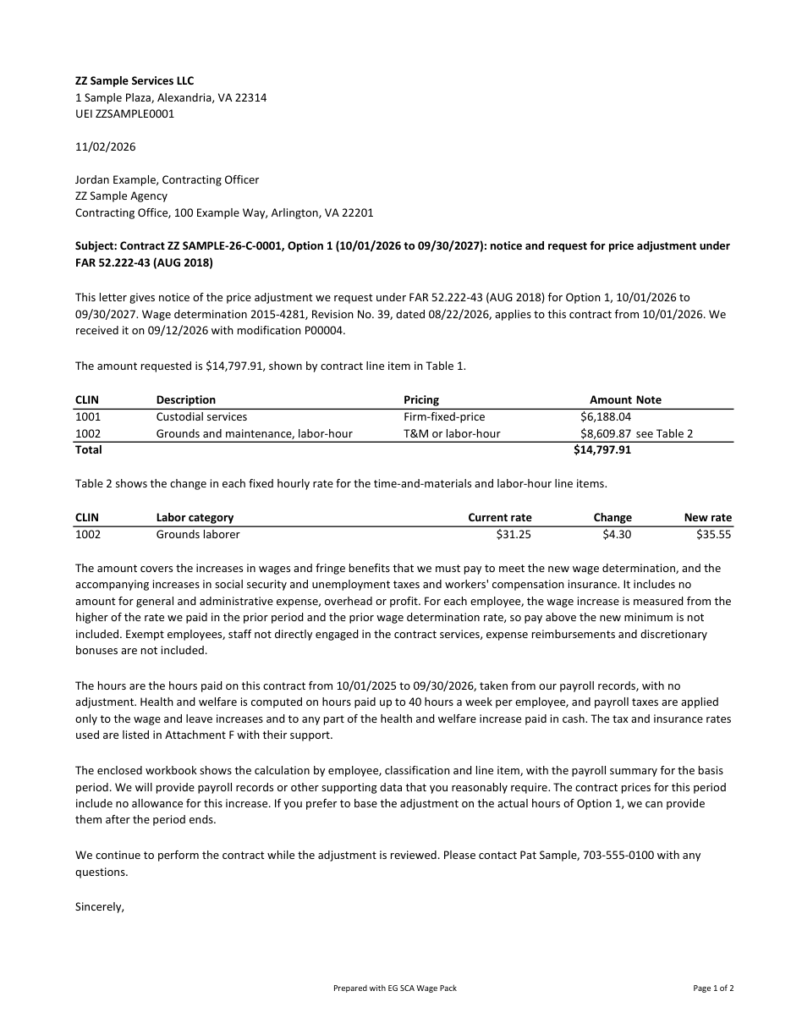
A draft letter in the same order as the skeleton: the notice, the wage determination and when it was received, the amount by CLIN, the labor-hour rate change, what the amount covers and leaves out, and the hours behind it. Screen from EG SCA Wage Pack (52.222-43), the Excel workbook that prepares and checks these numbers, with sample data.
The dates in the letter
The letter states its dates as facts: when you received the wage determination, when the period starts and ends, and the date of the letter. The clause counts its 30 days from receipt, and receipt can come well before the option is exercised. In Melwood Horticultural Training Center v. GSA (CBCA 8075, 2024), GSA’s 90-day notice of its intent to exercise the first option, dated November 1, 2022, carried the new wage determination and asked the contractor to say within thirty days whether it thought it was entitled to a price adjustment. Agency guidance can count from another date; our 52.222-43 guide sets them side by side under The 30-day notice.
A written extension from the contracting officer goes in the letter with its date. Under 52.222-44 the date that starts the 30 days is the effective date of the wage change, not receipt.
If the 30 days have passed, the letter states the dates as they are and nothing more. In Stobil Enterprise v. Department of Veterans Affairs (CBCA 5698, 2019), the board, quoting Air Masters, held that a late notice “does not defeat a contractor’s claim unless a contract clearly states an untimely submission will cause a contractor to lose rights, or unless an agency can demonstrate it was prejudiced by a late notice.” The VA did not argue prejudice. The amount still has to be proven from payroll, and that is where Stobil lost its wage request.
What the letter leaves out
Paragraph (f) asks for an amount, a rate change and support. It asks for no legal argument, no certification and no account of timing, and a notice that keeps to what it asks for leaves those out:
- Argument and threats. The letter is a statement of numbers with their basis, not a brief.
- A formal claim. The clause speaks of “the amount claimed”, but a claim under the Contract Disputes Act is a separate, later step. In Melwood the price adjustment proposal went to GSA in January 2023, and the certified claim came in November 2023, after the two sides disagreed about the hours. The skeleton calls the amount what it is: a request under the clause.
- Certification language. Paragraph (f) asks for none.
- Anything about lateness beyond the dates themselves.
- Costs the clause excludes. Overhead, G&A and profit, the cost of preparing the request, which the board refused in Stobil, and raises above the new minimum. The full list is under What is in the adjustment, and what is not.
Two optional sentences, each only if true
No allowance in the prices. Under paragraph (b) the contractor “warrants that the prices in this contract do not include any allowance for any contingency to cover increased costs for which adjustment is provided under this clause.” A letter can restate that, but only where it is true. In Corrections Corporation of America v. DHS (CBCA 2647, 2015), the agency argued the warranty was untrue because the contractor had raised each option year’s line item prices by three percent across the board; the board denied both sides summary relief so the facts could be developed. A letter whose option prices carried an escalation for SCA labor costs leaves this sentence out.
An offer of actual hours. A request sent before or early in the period rests on the prior period’s hours. The letter can offer to give the period’s actual hours once it ends. In Melwood, GSA asked the contractor to “provide payrolls so that we [can] review based on [the] actuals”, and the board upheld GSA’s count from the hours actually worked.
The attachments
The clause asks for “any relevant supporting data, including payroll records, that the Contracting Officer may reasonably require”, and paragraph (g) lets the contracting officer examine “any directly pertinent books, documents, papers and records” until 3 years after final payment. A request built to be checked without a second round of letters encloses:
- A. The amount by contract line item (Table 1).
- B. The change in each fixed hourly rate of a time-and-materials or labor-hour line item (Table 2).
- C. The calculation by employee and classification.
- D. A payroll summary for the basis period: classification, rate paid, hours worked and paid leave hours.
- E. Health and welfare support: what went to a plan and what was paid as cash in lieu.
- F. The payroll tax and workers’ compensation rates used, with their support.
- G. The old and new wage determinations, or the CBA-based wage determination and the agreement.
What each attachment should hold, item by item, is under What to send the contracting officer.
Before you sign a bilateral modification
A modification may come for signature while the request is still open. Two decisions show what a signature can do. In Air Masters, a bilateral modification that set a new contract price, signed without reserving the right to ask for an increase for the revised wage determinations, counted against the contractor, as did its silence when it received unilateral modifications that did not raise the price. In Stobil, the release language in two bilateral modifications was enforced, except where the modification expressly reserved the contractor’s right to pursue its request. Read a modification’s release language against the open request before you sign it.
Common questions
When do the 30 days for a 52.222-43 notice start?
The clause counts from when you receive the new wage determination, unless the contracting officer extends the period in writing. Receipt can come with the agency’s notice of intent to exercise the option: in Melwood (CBCA 8075), GSA’s 90-day option notice carried the wage determination and asked for notice within thirty days. Under 52.222-44 the 30 days run from the effective date of the wage change.
Is sending the new wage determination to the contracting officer enough notice?
No. In Air Masters Corp. v. GSA (GSBCA 16327, 2004), copies of the revised wage determinations and collective bargaining agreements were not the notice, because paragraph (f) requires a statement of the amount claimed and the documents held none.
Do I have to send payroll records with the letter?
The clause asks for any relevant supporting data, including payroll records, that the contracting officer may reasonably require, and paragraph (g) lets the contracting officer examine pertinent records until 3 years after final payment. In Melwood (CBCA 8075), GSA asked for the base year payrolls to review the request, and the board upheld its count from the hours actually worked.
Check it in your own payroll
EG SCA Wage Pack (52.222-43) is an Excel workbook that prepares and checks the numbers behind this letter from your own payroll export, and prepares the evidence pack: the draft letter with its two tables, Table 1 by CLIN and Table 2 for each fixed hourly rate, a backup workbook holding the letter and attachments A to G, and a PDF of the letter and its tables. It shows the notice date, 30 days from when you received the new wage determination, and if the date has passed the letter states the dates and nothing more. The letter is a draft for you to review, edit, sign and send; it makes no legal argument and certifies nothing.
See EG SCA Wage Pack (52.222-43)30-day free trial, no card needed. Excel for Windows, or Excel for Mac (Microsoft 365 or Excel 2024).
Sources
Primary sources, as read on November 3, 2026. They change; the current versions are the ones that count.
- FAR 52.222-43 (AUG 2018) (www.acquisition.gov), FAC 2026-01: paragraphs (b), (c), (e), (f) and (g)
- FAR 52.222-44 (MAY 2014) (www.acquisition.gov), the 30 days and the notice
- Revolutionary FAR Overhaul, Part 52 model deviation text (www.acquisition.gov), 52.222-43 as prescribed in 22.1002-2(d)(1)
- Air Masters Corp. v. GSA, GSBCA 16327 (2004) (gsbca.gsa.gov)
- Stobil Enterprise v. Department of Veterans Affairs, CBCA 5698 (2019) (PDF) (cbca.gov)
- Melwood Horticultural Training Center v. GSA, CBCA 8075 (2024) (PDF) (cbca.gov)
- Corrections Corporation of America v. DHS, CBCA 2647 (2015) (PDF) (www.cbca.gov)
More Service Contract Act guides: FAR 52.222-43 Price Adjustments for Service Contract Act Contractors · SCA Health and Welfare: The 2026 Rate and the Hours That Earn It · How to Read an SCA Wage Determination · Common SCA Payroll Mistakes, and How to Catch Them · SCA Holiday Pay: Who Earns It, How Much, and a Holiday Worked · SCA Vacation: Service, Vesting and the Deadline to Give It · Successor Contractors and CBA Wage Rates Under the SCA · SCA Conformance: When an Occupation Is Not on the Wage Determination · Service Contract Act vs. Davis-Bacon: Which Applies, and What Changes · Executive Order Minimum Wage and Paid Sick Leave on SCA Contracts · All SCA guides
★★★★★
“Most likely one of the best freelancers I’ve had the opportunity of working with. I would highly recommend David for any complex VBA coding. We’ll be working with him again in the future.”
VBA Development Client · via Upwork, 2020
5.0★ across 230+ client reviews · 100% Job Success on Upwork · Building Excel tools since 2010 · Read the reviews →