
Common SCA Payroll Mistakes, and How to Catch Them
ExcelGurus is not affiliated with, endorsed by, or acting for the U.S. Department of Labor, the U.S. General Services Administration or any other federal agency. This guide describes the regulations, clauses and decisions it cites as read on October 30, 2026; they change, so check them, the clauses in your own contract and its current wage determination before you rely on it. It is not legal advice.
Fringe benefits are where Service Contract Act (SCA) contractors are most often found short: in Department of Labor investigations completed from fiscal 2014 to 2019, fringe benefit violations appeared in 82 percent of the SCA cases with violations, and prevailing wage violations in 69 percent (GAO-21-11). The usual causes are health and welfare (H&W) averaged across employees or replaced with a higher wage, holidays and vacation not given or paid, employees placed in the wrong occupation, and overtime figured on the wrong base. EG SCA Wage Pack (52.222-43) checks each employee against the wage determination every pay period from your payroll export, and each finding names the rule it comes from.
What the Department of Labor finds
The Government Accountability Office looked at 5,261 SCA cases that the Wage and Hour Division (WHD) completed in fiscal years 2014 to 2019 (GAO-21-11, October 2020). WHD found violations in 68 percent of them. Among the cases with violations, fringe benefits were short in 82 percent and the wage rate itself in 69 percent, and more than half also had Fair Labor Standards Act (FLSA) violations. Employers agreed to pay about $224 million in back wages. GAO describes a fringe benefit violation as health and welfare, holiday or vacation benefits not provided, and the causes WHD named include employees placed in the wrong occupation, pay by the trip or the flat day instead of by the hour, the wrong wage determination, and bids too low to pay the one in the contract. The sector cited most is administrative support and waste management: janitorial, security and office services.
The twelve mistakes below are the ones behind those numbers. Each has the rule it breaks and a way to catch it in your own payroll before anyone else does.
Health and welfare
On a standard wage determination, H&W is a fixed amount per hour: $5.92 on the wage determinations revised since August 2026, or $5.42 on a contract that includes FAR 52.222-62 (paid sick leave under Executive Order 13706). The full rules are in our guide to SCA health and welfare; these are the four ways it goes wrong most often.
1. Averaging it across employees
A small employer buys one group plan with single and family premiums and checks the average against the wage determination. The regulation says “the amount of the employer’s contribution on behalf of each individual employee governs” (29 CFR 4.175(a)(2)), and Fact Sheet 67B says the employer “cannot average the cost across all employees.” Say the plan costs you $3.00 an hour for a single employee and $9.00 for a family: the average, $6.00, is above $5.92, but the single employee is $2.92 an hour short, $116.80 in a 40-hour week, and the family premium cannot make it up. Only a wage determination that states an average-cost benefit allows averaging, and All Agency Memorandum 246 says those may not be used for any new contract after July 16, 2024. Catch it: test each employee’s own H&W, never the total.
2. Counting a higher wage as health and welfare
“I pay $2 over the rate, so H&W is covered” is the most natural mistake, and it is wrong: an employer “cannot offset an amount of monetary wages paid in excess of the wages required” to meet its fringe obligation, and must keep records showing wages and fringe benefits separately (4.170(a)). Fact Sheet 67B’s example: with a Cook II rate of $19.50 and H&W of $4.98, you cannot pay $25.00 an hour and no H&W, or $22.00 and $2.48 in H&W. Cash in lieu of H&W is allowed, but as its own line on the pay stub and in the records. Catch it: look for employees with no plan and no H&W cash line, however high their rate.
3. Paying it on the wrong hours
H&W is due “for all hours paid for, including paid vacation, sick leave, and holiday hours, up to a maximum of 40 hours per week and 2,080 hours per year” on each contract (4.175(a)(1)). Two mistakes follow. Leaving out paid leave hours underpays. Applying the 40-hour limit to a pay period total instead of to each week gets the hours wrong: an employee who works 50 hours one week and 30 the next earns H&W on 70 hours, not on the 80 that a cap of 40 times two weeks would allow, and none on the 10 overtime hours. Catch it: count H&W hours week by week, paid leave included.
4. Counting the employee’s money, or leaving someone out
Employee contributions and payroll deductions never count toward H&W (4.171(a)(1)), and no deduction may be made “to cover any administrative costs” (4.172). An employee who is not in the plan, during a waiting period or after opting out, must get equivalent benefits or the cash equivalent for that time (4.175(c)(1)). Catch it: credit only the employer’s share, and look for anyone with H&W hours and neither a contribution nor cash.
Holidays, vacation and the rate for paid leave
5. Holidays tested by the wrong day
The test is not whether the employee was on the payroll that day. An employee who does any work in the workweek of a named holiday earns it, even when it falls on a Sunday or a day off (4.174(a)(1)), and so does one on paid vacation or sick leave all that week (4.174(a)(2)). One who works the holiday is paid for the work plus a day’s holiday pay up to 8 hours, or gets another day off with pay (4.174(c)(2)). Catch it: for each named holiday, list everyone with hours or paid leave in that week. Our SCA holiday pay guide covers part-time employees and weekend holidays.
6. Vacation that ignores the predecessor, or is never given
Length of service includes continuous service with predecessor contractors that did similar work at the same federal facility (4.173(a)(1)(ii)), so a successor can owe the incumbent’s long-serving employees their longer tiers on their next anniversary. The vacation vests on each anniversary and must be given or paid “before the next anniversary date, before completion of the current contract, or before the employee terminates employment, whichever occurs first” (4.173(c)(2)); whatever is left at termination is paid as a final cash payment (4.177(c)(6)). Catch it: keep each employee’s anniversary date, predecessor service included, and the deadline for each vested week. See our SCA vacation guide.
7. Paid leave at the wrong rate
Vacation is paid at the wage determination rate or the employee’s regular rate, “whichever is higher” (Field Operations Handbook 14j03(g)), at the rate in effect in the week it is taken or paid (4.173(e)(1)). When you pay a cash equivalent instead, it is figured on the employee’s regular rate if that is higher than the minimum (4.177(c)(2)). Catch it: compare each leave hour’s rate with the employee’s own rate for worked hours, not only with the wage determination.
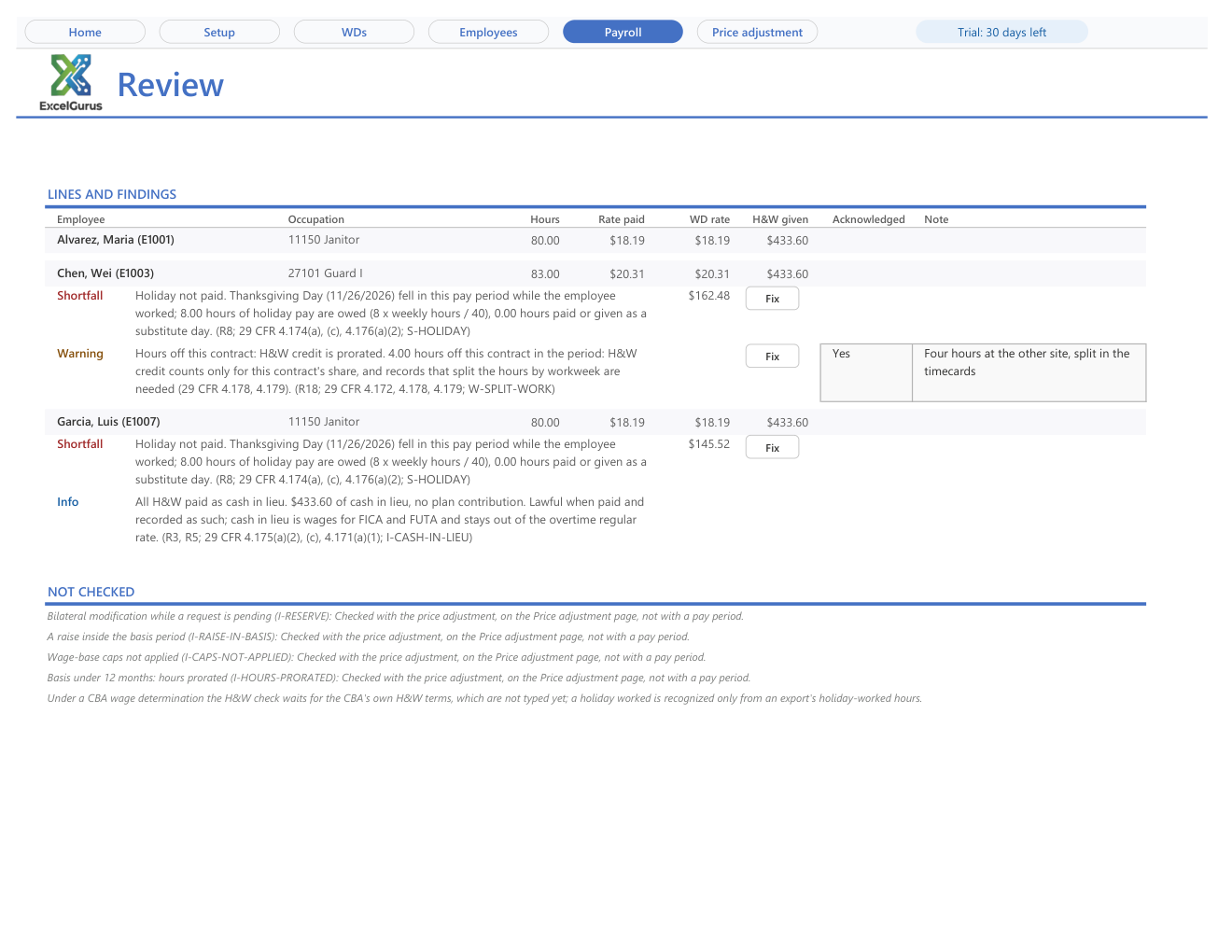
Mistake 5 as a finding: a holiday in the pay period with no holiday pay, the amount owed and the rule it comes from. Screen from EG SCA Wage Pack (52.222-43), the Excel workbook that prepares and checks these numbers, with sample data.
The wrong occupation
8. Misclassification, and work no class covers
GAO’s example is a help desk paid as Data Entry Operators instead of Personal Computer Support Technicians. The wage determination puts it plainly: “it is not the job title, but the required tasks” that decide whether a class is on it. Work that no listed class covers needs a conformance: Standard Form 1444 goes to the contracting officer no later than 30 days after the unlisted class first performs contract work (FAR 52.222-41(c)(2)(ii)), and the rate finally set is owed from the first day of that work. Catch it: match each employee’s duties, not the title on your payroll, to the occupation on the wage determination; our guide to reading a wage determination shows where to look, and our conformance guide covers SF-1444.
9. Two classes in one workweek, hours not split
An employee who works in two classes in a week “must be paid the highest of such rates for all hours worked in the workweek” unless your records show which hours went to each (4.169). Splitting is allowed only between different classes, such as janitor and window cleaner; levels of one class, such as Guard I and Guard II, cannot be split, so the higher level’s rate applies to every hour (Field Operations Handbook 14g01). Catch it: any employee with two occupations in a week needs hours by class in the records.
Paying by the hour, and overtime on the right base
10. A flat day or a trip rate
You may pay by the day, the week, the piece or the task, but the pay, reduced to an hourly rate each workweek, must give every hour of contract work at least the required rate, and overpaid hours cannot make up for underpaid ones (4.166). A flat day rate that looks generous for 8 hours can fall short in a 10-hour day. Catch it: divide each week’s pay by the hours actually worked, class by class.
11. Overtime figured on the wrong base
The SCA itself requires no overtime premium (4.180). Overtime comes from the FLSA, which applies on its own (4.181(a)), and from the Contract Work Hours and Safety Standards Act where the contract includes FAR 52.222-4, which is left out of contracts valued at or below $200,000 and of commercial products and services (FAR 22.305). Both require time and a half for hours over 40 in a workweek. The base is the regular rate: it includes night shift and hazard differentials (29 CFR 778.207(b)), leaves out H&W plan contributions and H&W cash in lieu (4.177(e)), and is never below the wage determination rate (4.182). Catch it: work out each week’s regular rate before the premium, never from the total pay including H&W cash.
Records
12. Records that cannot show what was paid
For each employee you keep the classification, the rates of wages and fringe benefits, payments in lieu of fringe benefits, daily and weekly hours and pay, and deductions, for 3 years from the completion of the work (FAR 52.222-41(i)(1); 29 CFR 4.6(g)(1)). Wages and hours are figured on a fixed, recurring 7-day workweek, and the records are kept that way (4.165(b)). Records behind a FAR 52.222-43 price adjustment stay open to the contracting officer until 3 years after final payment (52.222-43(g)). Fixing an underpayment is your cost: the 52.222-43 price adjustment measures its increase from at least the old minimum, so it never pays for bringing pay up to it.
A check for each pay period
| Mistake | What to compare | Rule |
|---|---|---|
| H&W averaged or offset | Each employee’s own employer contribution or cash, against the rate times H&W hours | 4.175(a)(2), 4.170(a) |
| H&W hours | Hours paid each week, paid leave included, capped at 40 | 4.175(a)(1) |
| Holidays | Everyone with work or paid leave in a holiday’s week | 4.174(a) |
| Vacation | Vested weeks against each deadline | 4.173(c) |
| Leave rate | Leave hours against the higher of the WD rate and the employee’s rate | FOH 14j03(g) |
| Occupation | Duties against the wage determination; SF-1444 within 30 days | 52.222-41(c)(2) |
| Two classes | Hours split by class in the records | 4.169 |
| Overtime | Time and a half of the regular rate over 40 in a week | 4.181, 4.182 |
Common questions
Can I average health and welfare across my employees?
No. The employer’s contribution for each employee governs (29 CFR 4.175(a)(2)), so a family premium cannot cover a single employee’s gap. Only a wage determination that states an average-cost benefit allows averaging, and All Agency Memorandum 246 says those may not be used for any new contract after July 16, 2024.
Does the Service Contract Act require overtime pay?
The SCA itself does not. Overtime comes from the Fair Labor Standards Act, which applies on its own, and from the Contract Work Hours and Safety Standards Act where the contract includes FAR 52.222-4. Both require time and a half for hours over 40 in a workweek.
How long do I keep SCA payroll records?
Three years from the completion of the work (FAR 52.222-41(i)(1)). Records behind a 52.222-43 price adjustment stay open to the contracting officer until 3 years after final payment under the contract.
Check it in your own payroll
EG SCA Wage Pack (52.222-43) is an Excel workbook that prepares and checks the wage and fringe numbers of an SCA contract from your own payroll export. Its Shortfalls include a rate below the wage determination’s, health and welfare below the rate for the hours that earn it, per employee and never averaged, a holiday or vested vacation not given or paid, paid leave below the higher rate, and two classes in one workweek without the hours split; its Warnings include an occupation not on the wage determination and overtime below time and a half. The checks follow the regulations and the published guidance as of its release and may not catch every error; passing them does not mean that your pay meets the law.
See EG SCA Wage Pack (52.222-43)30-day free trial, no card needed. Excel for Windows, or Excel for Mac (Microsoft 365 or Excel 2024).
Sources
Primary sources, as read on October 30, 2026. They change; the current versions are the ones that count.
- GAO-21-11, Federal Contracting: Actions Needed to Improve Department of Labor’s Enforcement of Service Worker Wage Protections (October 2020) (www.gao.gov), SCA cases completed in fiscal years 2014 to 2019
- 29 CFR Part 4 (www.ecfr.gov), sections 4.6(g), 4.165, 4.166, 4.169 to 4.177 and 4.180 to 4.182
- 29 CFR 778.207, Other types of contract premium pay distinguished (www.ecfr.gov)
- FAR 52.222-41, Service Contract Labor Standards (www.acquisition.gov), paragraphs (c)(2) and (i)
- FAR 52.222-43 (www.acquisition.gov), paragraph (g)
- FAR 22.305, Contract clause (www.acquisition.gov)
- WHD Fact Sheet 67B, Meeting Requirements for SCA Fringe Benefits (October 2024) (www.dol.gov)
- WHD Field Operations Handbook, Chapter 14 (PDF) (www.dol.gov), 14g01 and 14j03
- All Agency Memorandum 246 (July 16, 2024) (PDF) (www.dol.gov)
- Wage determination 2015-5619, Revision 30 (August 27, 2026) (sam.gov), the 2026 H&W rates and the conformance note
More Service Contract Act guides: FAR 52.222-43 Price Adjustments for Service Contract Act Contractors · SCA Health and Welfare: The 2026 Rate and the Hours That Earn It · The SCA Price Adjustment Letter: What a 52.222-43 Notice Says · How to Read an SCA Wage Determination · SCA Holiday Pay: Who Earns It, How Much, and a Holiday Worked · SCA Vacation: Service, Vesting and the Deadline to Give It · Successor Contractors and CBA Wage Rates Under the SCA · SCA Conformance: When an Occupation Is Not on the Wage Determination · Service Contract Act vs. Davis-Bacon: Which Applies, and What Changes · Executive Order Minimum Wage and Paid Sick Leave on SCA Contracts · All SCA guides
★★★★★
“Most likely one of the best freelancers I’ve had the opportunity of working with. I would highly recommend David for any complex VBA coding. We’ll be working with him again in the future.”
VBA Development Client · via Upwork, 2020
5.0★ across 230+ client reviews · 100% Job Success on Upwork · Building Excel tools since 2010 · Read the reviews →