
SCA Holiday Pay: Who Earns It, How Much, and a Holiday Worked
ExcelGurus is not affiliated with, endorsed by, or acting for the U.S. Department of Labor, the U.S. General Services Administration or any other federal agency. This guide describes the regulations, clauses and decisions it cites as read on November 3, 2026; they change, so check them, the clauses in your own contract and its current wage determination before you rely on it. It is not legal advice.
On a Service Contract Act (SCA) contract, an employee who does any work in the workweek in which a named holiday falls earns that holiday, even when it falls on a Sunday or on a day the employee is not scheduled, and so does an employee on paid vacation or sick leave all that week. A full-time employee gets a full day’s pay up to 8 hours, a part-time employee a proportionate share, and an employee who works the holiday is paid for the work plus the holiday pay, or gets another day off with pay. Most standard wage determinations name eleven holidays, including Juneteenth and Columbus Day, and some name up to fourteen. EG SCA Wage Pack (52.222-43), an Excel workbook from ExcelGurus, reads the holidays from your wage determination and shows a holiday not given or paid when it checks your payroll export.
Which holidays are owed
The wage determination in your contract names them. Wage determination 2015-5619, Revision 30 (8/27/2026) is typical: “A minimum of eleven paid holidays per year: New Year’s Day, Martin Luther King Jr.’s Birthday, Washington’s Birthday, Memorial Day, Juneteenth National Independence Day, Independence Day, Labor Day, Columbus Day, Veterans’ Day, Thanksgiving Day, and Christmas Day.” Some areas name more. WD 2015-5681 (Anchorage, Alaska) names twelve, adding Good Friday; WD 2015-4837 (Bay County, Michigan) names fourteen, adding Good Friday, the day after Thanksgiving and Christmas Eve. The count is written as a word, so read the whole line on your own wage determination.
The same line lets you “substitute for any of the named holidays another day off with pay in accordance with a plan communicated to the employees involved.” The named holidays stay the reference points: whoever worked in the workweek of a named holiday is owed the substitute day (29 CFR 4.174(a)(3)).
A day the wage determination does not name is not owed. DOL’s Field Operations Handbook (14j04) says that a day declared a holiday by the President, or a day the federal facility closes, for example for weather, need not be paid unless the wage determination names it; any pay for it is “a matter of discretion for the contractor”.
Who earns the holiday
The rule is in 29 CFR 4.174(a)(1): “an employee who performs any work during the workweek in which a named holiday occurs is entitled to the holiday benefit, regardless of whether the named holiday falls on a Sunday, another day during the workweek on which the employee is not normally scheduled to work, or on the employee’s day off.”
- Any work in the workweek. The workweek is your fixed, regularly recurring seven-day week (4.165(b)). One shift in it is enough.
- No “day before and day after” rule. Holiday pay cannot be denied because the employee did not work the day before or after, or has not been employed for a set period, unless the wage determination says so (4.174(a)(1)).
- Paid leave all week. An employee who did no work that week because of paid vacation or sick leave is owed the holiday pay or another day off with pay (4.174(a)(2)). An employee who did no work and had no paid leave that week is generally not owed it.
- New hires. A holiday that fell before the employee was hired is generally not owed, and a temporary employee hired in the holiday week but after the holiday is owed none for that week (4.174(b), 4.176(a)(2)). The exception: when a named holiday falls in the first week of a contract, everyone who works that first week is owed it.
- Layoffs. A layoff over the holiday week does not end the entitlement if it is only a way to avoid paying the holiday (4.174(a)(2)).
How much: a full day’s pay up to 8 hours
A full-time employee who earns the holiday “must receive a full day’s pay up to 8 hours unless a different standard is used in the fringe benefit determination” (4.174(c)(1)). So an employee whose scheduled day is 7 hours gets 7 hours, and one whose scheduled day is 10 hours gets 8. Holiday pay “must include the full amount of other fringe benefits”, which is why holiday hours also earn health and welfare (below).
Part-time employees get a share in proportion to the time they work (4.176(a)):
- A regular schedule. An employee with a regular 16-hour week gets two-fifths of a full-time employee’s holiday pay, so 3.2 hours, whether or not the holiday falls on one of that employee’s workdays.
- An irregular schedule. The hours worked in the workweek before the holiday week, divided by 40, times 8. The regulation’s example: 10 hours the week before July 4 gives “10/40 times 8 = 2 hours holiday pay”.
A holiday worked
A full-time employee who works on the holiday “must be paid, in addition to the amount he ordinarily would be entitled to for that day’s work, the cash equivalent of a full-day’s pay up to 8 hours or be furnished another day off with pay” (4.174(c)(2)). An 8-hour shift on Thanksgiving is therefore 8 hours of pay for the work plus 8 hours of holiday pay, or the 8 hours of work plus another paid day off. The holiday pay comes on top of the pay for the hours worked; it never replaces it.
A Thanksgiving week, employee by employee
Thanksgiving Day 2026 is Thursday, November 26. Take a contractor whose workweek runs Sunday to Saturday, so the holiday week is November 22 to 28, and a wage determination that names Thanksgiving with the standard 8-hour day. The employees are made up to show the rules.
| Employee | That week | Holiday owed | Rule |
|---|---|---|---|
| A, full time, 8-hour days | Off on Thanksgiving, worked the other four days | 8 hours’ pay | 4.174(a)(1), (c)(1) |
| B, full time, 8-hour days | Worked an 8-hour shift on Thanksgiving | Pay for the 8 hours worked, plus 8 hours’ holiday pay or another day off with pay | 4.174(c)(2) |
| C, full time, 7-hour days | Off on Thanksgiving, worked the other four days | 7 hours’ pay | 4.174(c)(1) |
| D, part time, a regular 16 hours on Monday and Tuesday | Worked Monday and Tuesday | 3.2 hours’ pay (two-fifths of 8) | 4.176(a)(2) |
| E, part time, irregular hours | Worked 6 hours; 10 hours the week before | 2 hours’ pay (10/40 of 8) | 4.176(a)(3)(i) |
| F, full time | On paid vacation all week | 8 hours’ pay, or another day off with pay | 4.174(a)(2) |
| G, new hire | Started on Friday, November 27 | None | 4.174(b), 4.176(a)(2) |
| H, full time | On unpaid leave all week | None | 4.174(a)(2) |
At a rate of $20.00 an hour, A’s holiday is $160.00 and B’s Thanksgiving is $160.00 for the shift plus $160.00 of holiday pay. Nobody in the table had to work on Wednesday or Friday to qualify, and D is owed a share although Thursday is not one of D’s workdays.
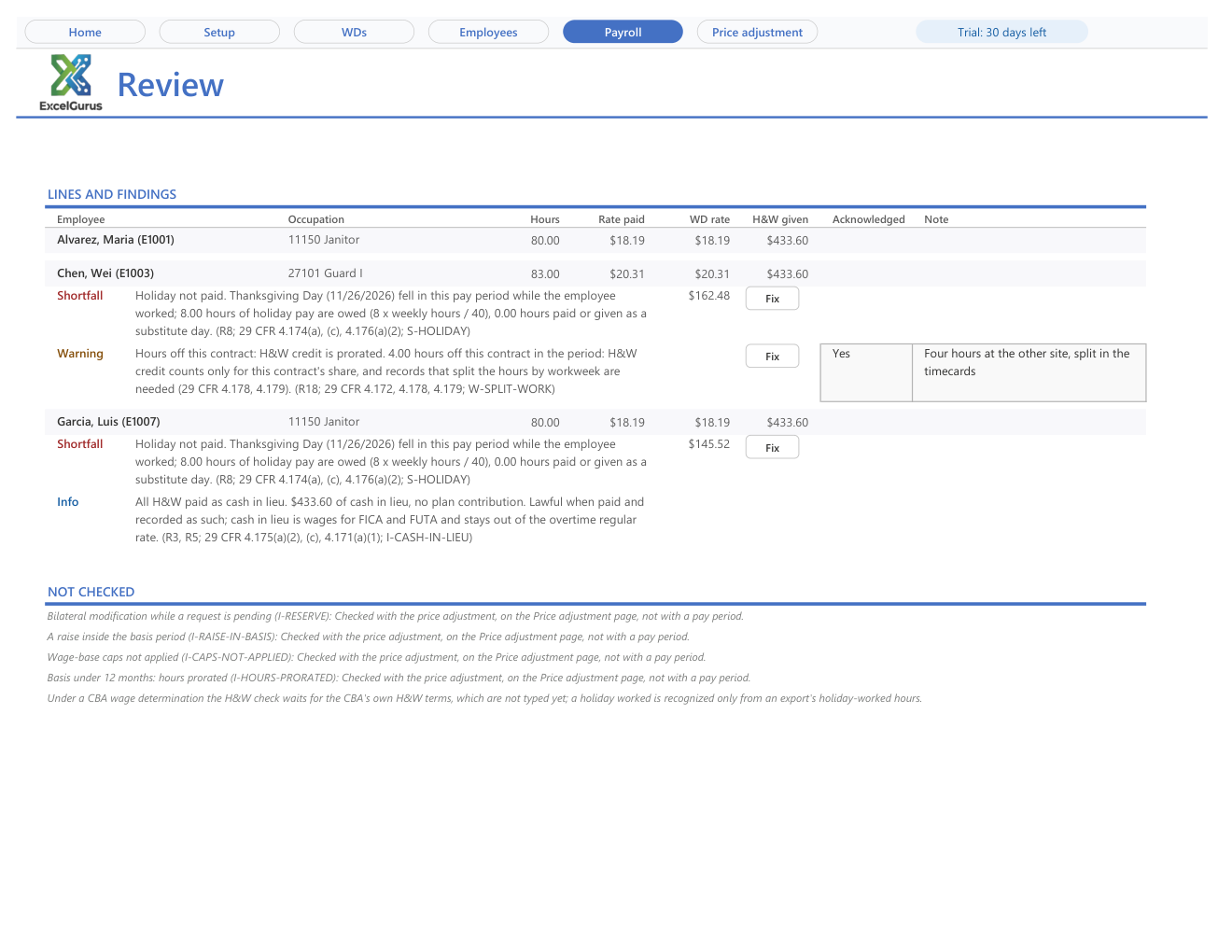
Thanksgiving Day in a sample pay period: a Shortfall under each employee who was owed the holiday and was not paid it, with the amount owed and the rule it comes from. Screen from EG SCA Wage Pack (52.222-43), the Excel workbook that prepares and checks these numbers, with sample data.
Holidays that fall on a weekend
A weekend holiday is still earned: the test is work in the workweek, not a scheduled workday. Which date counts is a different question, and neither the wage determination nor Part 4 sets it. The regulation’s own example in 4.174(b) speaks of New Year’s Day “officially celebrated on January 2” in a year when January 1 fell on a Sunday. That matters when the observed day falls in another workweek: a Sunday holiday observed on Monday moves to the next Sunday-to-Saturday week. Independence Day 2027 is a Sunday and Christmas Day 2027 a Saturday, so decide ahead of time which date you treat as the holiday, tell your employees, and apply the workweek test to that date. If the reading is in doubt on your contract, ask your contracting officer or the Wage and Hour Division.
Cash instead of the day off, and final pay
You may pay a cash equivalent instead of giving the day off, on the regular payday and in addition to the wage (29 CFR 4.177(c)(1)). As an hourly amount, it is the employee’s rate times the holiday hours, divided by 2,080 (4.177(c)(5)); with eleven 8-hour holidays at $20.00 an hour, that is $1,760.00 a year, or $0.8462 an hour. Where the employee’s own rate is above the wage determination rate, the computation uses the employee’s rate (4.177(c)(2)). Wages paid above the wage determination rate never count toward the holiday (4.170(a)), and the holiday pay is recorded as holiday pay.
Holiday pay vests once the employee works in the holiday’s workweek, so an employee who leaves before it is paid must get it “as a final cash payment” (4.174(c)(4)). Holiday plans may be unfunded: you pay holidays from payroll as they come, which Fact Sheet 67B and 4.171(b)(1) allow for vacations and holidays.
Holiday hours earn health and welfare
Holiday hours are hours paid, so they earn health and welfare like hours worked, within the 40-hour week: 32 hours worked plus 8 holiday hours earn 40, and more hours worked plus the holiday still earn 40 (29 CFR 4.175(a)(1)(ii)). The health and welfare guide works a two-week pay period with Thanksgiving in it, hour by hour.
A holiday added at an option
When the wage determination that comes in at an option or anniversary adds a holiday, FAR 52.222-43 can adjust the contract price for it, unless you already give that day off with pay, and your paid holiday hours are part of the hours a price adjustment is priced on. The FAR 52.222-43 price adjustment guide shows how an added holiday is valued.
Common questions
Does an SCA employee have to work the day before and after a holiday to get paid for it?
No, unless the wage determination says so. Under 29 CFR 4.174(a)(1), any work in the workweek in which the named holiday falls earns it, even when the holiday falls on a Sunday or the employee’s day off, and holiday pay cannot be denied because the employee did not work the day before or after.
Do part-time SCA employees get holiday pay?
Yes, in proportion to their hours. With a regular 16-hour week, two-fifths of a full day’s holiday pay, whether or not the holiday falls on one of their workdays; with an irregular schedule, the hours worked in the week before the holiday week divided by 40, times 8 (29 CFR 4.176(a)(2) and (a)(3)(i)).
What do I owe an employee who works on a named holiday?
The pay for the hours worked, plus a full day’s holiday pay up to 8 hours, or another day off with pay, unless the wage determination sets a different standard (29 CFR 4.174(c)(2)).
Check it in your own payroll
EG SCA Wage Pack prepares and checks the wage and fringe numbers of an SCA contract from your own payroll export. It reads the holidays from the wage determination you import, and its findings include a Shortfall for a holiday not given or paid, and for paid leave below the higher of the wage determination’s rate and the employee’s own rate. Each finding names the employee, the pay period, what the wage determination requires, what was paid, the amount short and the rule it comes from. The checks follow the regulations and the published guidance as of its release and may not catch every error; passing them does not mean that your pay meets the law.
See EG SCA Wage Pack (52.222-43)30-day free trial, no card needed. Excel for Windows, or Excel for Mac (Microsoft 365 or Excel 2024).
Sources
Primary sources, as read on November 3, 2026. They change; the current versions are the ones that count.
- 29 CFR Part 4, Labor Standards for Federal Service Contracts (www.ecfr.gov), 4.165(b), 4.170, 4.171, 4.174, 4.175(a)(1), 4.176, 4.177(c)
- WHD Fact Sheet 67B, Meeting Requirements for Fringe Benefits under the SCA (www.dol.gov), October 2024
- Wage determination 2015-5619, Revision 30 (sam.gov), last revised 8/27/2026: eleven holidays
- Wage determination 2015-5681, Revision 29 (sam.gov), last revised 8/27/2026: twelve holidays
- Wage determination 2015-4837, Revision 31 (sam.gov), last revised 8/13/2026: fourteen holidays
- WHD Field Operations Handbook, Chapter 14 (PDF) (www.dol.gov), 14j04, holiday pay
More Service Contract Act guides: FAR 52.222-43 Price Adjustments for Service Contract Act Contractors · SCA Health and Welfare: The 2026 Rate and the Hours That Earn It · The SCA Price Adjustment Letter: What a 52.222-43 Notice Says · How to Read an SCA Wage Determination · Common SCA Payroll Mistakes, and How to Catch Them · SCA Vacation: Service, Vesting and the Deadline to Give It · Successor Contractors and CBA Wage Rates Under the SCA · SCA Conformance: When an Occupation Is Not on the Wage Determination · Service Contract Act vs. Davis-Bacon: Which Applies, and What Changes · Executive Order Minimum Wage and Paid Sick Leave on SCA Contracts · All SCA guides
★★★★★
“Most likely one of the best freelancers I’ve had the opportunity of working with. I would highly recommend David for any complex VBA coding. We’ll be working with him again in the future.”
VBA Development Client · via Upwork, 2020
5.0★ across 230+ client reviews · 100% Job Success on Upwork · Building Excel tools since 2010 · Read the reviews →