
SCA Health and Welfare: The 2026 Rate and the Hours That Earn It
ExcelGurus is not affiliated with, endorsed by, or acting for the U.S. Department of Labor, the U.S. General Services Administration or any other federal agency. This guide describes the regulations, clauses and decisions it cites as read on November 3, 2026; they change, so check them, the clauses in your own contract and its current wage determination before you rely on it. It is not legal advice.
On a standard Service Contract Act (SCA) wage determination revised since August 2026, health and welfare (H&W) is $5.92 an hour, or $5.42 an hour on a contract that includes FAR 52.222-62 (paid sick leave under Executive Order 13706). It is owed for every hour paid, paid vacation, holiday and sick hours included, up to 40 hours a week and 2,080 hours a year, and nothing is owed on hours over 40 in a week. Each employee must receive the full amount: a family premium cannot be averaged with a single one across the workforce, and wages above the wage determination rate do not count toward it. EG SCA Wage Pack (52.222-43), an Excel workbook from ExcelGurus, checks each employee’s health and welfare against the wage determination from your own payroll export.
The two rates, and which one is yours
Every standard wage determination prints two H&W lines. Wage determination 2015-5619, Revision 30 (last revised 8/27/2026) reads “$5.92 per hour, up to 40 hours per week, or $236.80 per week or $1,026.13 per month”, and below it “HEALTH & WELFARE EO 13706: $5.42 per hour”, with a note that the lower rate is “to be used only when compensating employees for performance on an SCA-covered contract also covered by EO 13706”.
The lower rate exists because Executive Order 13706 sick leave is a separate obligation. The Department of Labor sets an alternate rate “that excludes the portion of the standard health and welfare rate attributed to paid sick leave” (All Agency Memorandum 246), and a contractor cannot count the sick leave the order requires toward its SCA wage or fringe obligations (29 CFR 13.5(f)(2)(i) and paragraph (g) of FAR 52.222-62). Paid sick time beyond what the order requires may count (13.5(f)(2)(ii)).
Which rate is yours depends on one thing: whether the contract includes FAR 52.222-62. The order covers contracts from solicitations issued on or after January 1, 2017, contracts awarded outside a solicitation on or after that date, and older contracts renewed or extended by bilateral negotiation after it. The government’s unilateral exercise of a pre-negotiated option does not make a contract new for the order (29 CFR 13.2). So check the clause list in your contract, not the date on the wage determination. The guide to the executive order minimum wage and paid sick leave covers the order itself.
Two kinds differ. Hawaii wage determinations carry lower levels for employees covered by the Hawaii Prepaid Health Care Act (AAM 246). And a wage determination for a successor contract under section 4(c) carries the predecessor’s collective bargaining agreement benefits, which can be stated differently; the 40-hour rule below applies “unless otherwise specified” (29 CFR 4.172). See successor contractors and CBA wage rates.
The rates by year
DOL raises the rate about once a year in an All Agency Memorandum (AAM), and each wage determination carries it as it is revised. The weekly figure is the hourly rate times 40, and the monthly figure the hourly rate times 40 times 52, divided by 12.
| Wage determinations revised | Standard H&W | EO 13706 H&W | Where it is stated |
|---|---|---|---|
| From July 16, 2024 | $5.36 an hour ($214.40 a week, $929.07 a month) | $4.93 ($197.20, $854.53) | AAM 246, July 16, 2024 |
| From July 2025 | $5.55 ($222.00, $962.00) | $5.09 ($203.60, $882.27) | AAM 250, July 7, 2025; WD 2015-4281 Rev 34, 7/8/2025 |
| From August 2026 | $5.92 ($236.80, $1,026.13) | $5.42 ($216.80, $939.46) | AAM 252, August 10, 2026; WD 2015-5619 Rev 30, 8/27/2026 |
A new rate does not reach your contract the day DOL publishes it. The wage determination “current on the anniversary date of a multiple year contract or the beginning of each renewal option period” applies (FAR 52.222-43(c)), because each option period is a new contract for SCA purposes (29 CFR 4.145(a)). Until then, the rates in your contract keep applying.
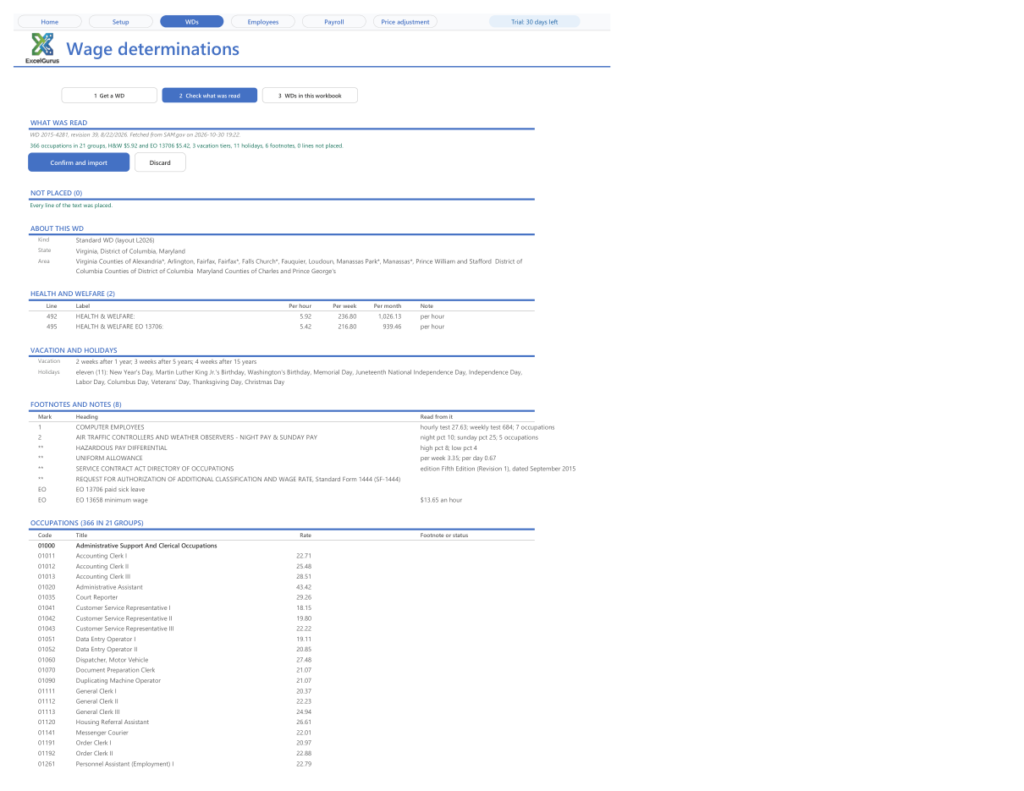
Both health and welfare rates as they are read from a wage determination revised in 2026: $5.92 an hour, and $5.42 under EO 13706. Screen from EG SCA Wage Pack (52.222-43), the Excel workbook that prepares and checks these numbers, with sample data.
Which hours earn it
The rule is in 29 CFR 4.175(a)(1): H&W is due “for all hours paid for, including paid vacation, sick leave, and holiday hours, up to a maximum of 40 hours per week and 2,080 hours per year on each contract.” Section 4.172 explains the numbers as “the typical number of nonovertime hours of work in a week, and in a year”. The regulation’s own examples:
- Four 10-hour days earn 40 hours of H&W; three 12-hour days earn 36.
- 32 hours worked plus 8 hours of holiday pay earn 40. More than 32 hours worked plus the holiday still earn only 40.
- Two weeks of vacation with 80 hours of vacation pay earn 80 hours of H&W.
- An employee who works all 52 weeks and is paid vacation in lieu of taking it has already earned 2,080 hours, so the vacation pay carries no extra H&W.
Hours over 40 in a workweek earn no H&W, and none is owed on the overtime premium. The 40-hour limit is a weekly limit: it applies to each of your fixed, regularly recurring seven-day workweeks (29 CFR 4.165(b)), not to a pay period total. A part-time employee earns H&W on the hours paid, so a regular 20-hour week earns half the full-time amount (4.176(a)(4)).
A two-week pay period, week by week
A full-time guard on the standard 2026 rate, in a pay period that covers Thanksgiving week. The hours are made up to show the method.
| Workweek | Hours worked | Of which overtime | Paid leave hours | Hours that earn H&W | H&W at $5.92 |
|---|---|---|---|---|---|
| November 15 to 21 | 48 | 8 | 0 | 40 | $236.80 |
| November 22 to 28 (Thanksgiving) | 36 | 0 | 8 (holiday) | 40 | $236.80 |
| Pay period | 84 | 8 | 8 | 80 | $473.60 |
- Week one’s 8 overtime hours earn nothing. Week two’s 36 worked hours plus the 8 holiday hours are 44 hours paid, but the week stops at 40.
- H&W paid only on straight-time hours worked (40 plus 36, so 76) would be $449.92, $23.68 short: the holiday hours earn H&W too.
- H&W paid on every hour paid (92) would be $544.64, more than the wage determination requires.
The week matters even when the period total looks right. Had the guard worked 50 hours and then 30, the period shows 80 hours, but the weekly rule counts 40 plus 30, so 70 hours ($414.40), not 80. A payroll export with pay period totals only cannot tell those two cases apart.
Employee by employee, never averaged
For the standard rate, “the amount of the employer’s contribution on behalf of each individual employee governs” (29 CFR 4.175(a)(2)). Fact Sheet 67B puts it plainly: “The employer cannot average the cost across all employees.” You may pay different amounts to different employees, as long as each one gets at least the wage determination amount for his or her own H&W hours.
An example with made-up premiums. Two full-time employees each earn the full $1,026.13 a month. Your plan costs $700.00 a month for single coverage and $1,400.00 for family coverage. The average is $1,050.00, above the requirement, but the employee with single coverage is $326.13 short every month, and that gap has to be paid in cash or in other bona fide benefits. The family premium’s extra $373.87 does not cover it.
The one exception is a wage determination that states H&W as an average cost (4.175(b)). Those were issued only for contracts awarded before 1997 and performed without interruption since, and AAM 246 says they “will not be issued, and may not be used, for any new contracts” after July 16, 2024. Since every option period is a new contract, you should rarely see one.
How to pay it: a plan, cash in lieu, or both
- A bona fide plan. The plan is in writing and communicated to the employees in writing, has a definite formula for contributions and benefits, and your contributions go irrevocably to a trustee or other third party, such as an insurer (29 CFR 4.171(a)). An unfunded self-insured plan needs the Administrator’s approval, except for vacation and holidays (Fact Sheet 67B).
- Only your money counts. Employee contributions and payroll deductions never count toward H&W (4.171(a)(1)), and you cannot deduct your own administrative costs from the required amount (4.172). A plan that costs less than the rate leaves a difference to pay in cash or equivalent benefits.
- Employees outside the plan. An employee excluded from the plan, or not enrolled, must get equivalent benefits or a cash equivalent (4.175(c)(1)). During a waiting period, contributions you make still count; if you make none, you get no credit (4.175(c)(2)).
- Cash in lieu, and timing. Cash in lieu is an amount per hour paid on the regular payday in addition to the wage (4.177(c)(1)). Plan payments may be made no less often than quarterly (4.175(d)(1)). Where the plan requires monthly contributions, DOL’s Field Operations Handbook (14j06) asks you to reconcile what they cost against the H&W owed at least monthly.
A higher wage never covers it
“An employer cannot offset an amount of monetary wages paid in excess of the wages required under the determination in order to satisfy his fringe benefit obligations under the Act, and must keep appropriate records separately showing amounts paid for wages and amounts paid for fringe benefits” (29 CFR 4.170(a)). Fact Sheet 67B gives a cook with a $19.50 rate and $4.98 of H&W: paying $25.00 an hour and no H&W does not meet it, and neither does $22.00 plus $2.48. It works the other way too: H&W paid cannot make up a wage below the wage determination rate (4.177(a)(1)).
Cash in lieu is allowed, but it has to be paid and recorded as H&W. A single higher hourly rate with no separate H&W line on the payroll record is a wage, and Fact Sheet 67B warns that failing to keep the cash H&W separate “may result in a finding that the contractor failed to pay all or a portion of the fringe benefits”.
Taxes on cash in lieu
The IRS has answered this in general information letter 2011-0074, relying on Rev. Rul. 75-241. Payments you make directly to an insurer or carrier for health and welfare benefits are not wages for social security, Medicare or federal unemployment tax (Internal Revenue Code sections 3121(a)(2) and 3306(b)(2)). Cash paid to the employee in lieu of the benefits, where the employee “has complete control over the disposition of the cash payments”, is wages for income tax withholding, FICA and FUTA. State unemployment tax and workers’ compensation follow your state’s rules and your carrier’s.
The choice also changes a price adjustment: the employer taxes on an H&W increase apply only to the part paid in cash, as the FAR 52.222-43 price adjustment guide explains.
Where the sources differ
Two questions have no single answer. First, an employee who works on two of your SCA contracts in one week: 29 CFR 4.175(a)(1) and 4.172 apply the cap “on each contract” and give full fringe benefits “under each contract”, while the Field Operations Handbook (14j00(f)) caps a single employer’s fixed-cost fringe payments at 40 hours a week “regardless of the number of contracts”, citing Dantran, Inc. v. U.S. DOL (1st Cir. 1999). Second, the regulation does not say whether the 2,080-hour year is the calendar, contract or anniversary year. If either comes up, ask your contracting officer or the Wage and Hour Division.
When the rate rises at an option
When the option period brings in a wage determination with a higher rate, FAR 52.222-43 adjusts the contract price for the H&W increase you actually have to pay: the new rate minus the higher of the old rate and the hourly cost of the H&W you actually provided, on the capped hours in your payroll. The price adjustment guide works that through with numbers. Averaged premiums, H&W skipped on holiday and vacation hours, and a higher wage standing in for H&W are among the common SCA payroll mistakes.
Common questions
Do I owe SCA health and welfare on overtime hours?
No. It is owed on hours paid up to 40 in a workweek and 2,080 a year, paid vacation, holiday and sick hours included. Hours over 40 in a workweek earn none, and none is owed on the overtime premium (29 CFR 4.175(a)(1) and 4.172).
Can I pay a higher hourly wage instead of health and welfare?
Not as a higher wage alone. Under 29 CFR 4.170(a), wages above the wage determination rate cannot be offset against the fringe obligation, and the records must show wages and fringe benefits separately. Cash in lieu of health and welfare is allowed when it is paid on the regular payday and recorded as such.
Which health and welfare rate applies to my contract, $5.92 or $5.42?
On wage determinations revised since August 2026, the lower EO 13706 rate of $5.42 applies only if your contract includes FAR 52.222-62, Paid Sick Leave Under Executive Order 13706; otherwise the standard $5.92 applies. Check the clause list in your contract and the wage determination attached to the current period.
Check it in your own payroll
EG SCA Wage Pack prepares and checks the wage and fringe numbers of an SCA contract from your own payroll export, where you map the health and welfare contribution and the cash in lieu as their own columns. Its findings include a Shortfall for health and welfare below the rate for the hours that earn it, up to 40 a week, per employee and never averaged; wages above the rate do not cover a health and welfare gap, and the finding says so. With hours by workweek, the weekly rules are checked exactly; with pay period totals only, a gap that depends on how the hours fall in weeks is shown as a warning that says so. The checks follow the regulations and the published guidance as of its release and may not catch every error; passing them does not mean that your pay meets the law.
See EG SCA Wage Pack (52.222-43)30-day free trial, no card needed. Excel for Windows, or Excel for Mac (Microsoft 365 or Excel 2024).
Sources
Primary sources, as read on November 3, 2026. They change; the current versions are the ones that count.
- 29 CFR Part 4, Labor Standards for Federal Service Contracts (www.ecfr.gov), 4.145(a), 4.161, 4.165(b), 4.170 to 4.172, 4.175 to 4.177
- WHD Fact Sheet 67B, Meeting Requirements for Fringe Benefits under the SCA (www.dol.gov), October 2024
- All Agency Memorandum 246 (PDF) (www.dol.gov), July 16, 2024: the 2024 rates, the EO 13706 rate, average cost wage determinations, Hawaii
- SAM.gov, All Agency Memoranda (sam.gov), AAM 250 (July 7, 2025) and AAM 252 (August 10, 2026)
- Wage determination 2015-5619, Revision 30 (sam.gov), last revised 8/27/2026: the 2026 rates
- Wage determination 2015-4281, Revision 34 (sam.gov), last revised 07/08/2025: the 2025 rates
- 29 CFR Part 13, Establishing Paid Sick Leave for Federal Contractors (www.ecfr.gov), 13.2 and 13.5(f)(2)
- FAR 52.222-62, Paid Sick Leave Under Executive Order 13706 (www.acquisition.gov), paragraph (g)
- FAR 52.222-43, Price Adjustment (Multiple Year and Option Contracts) (www.acquisition.gov), paragraph (c)
- IRS information letter 2011-0074 (PDF) (www.irs.gov), cash in lieu of health and welfare benefits
- WHD Field Operations Handbook, Chapter 14 (PDF) (www.dol.gov), 14j00(f) and 14j06
More Service Contract Act guides: FAR 52.222-43 Price Adjustments for Service Contract Act Contractors · The SCA Price Adjustment Letter: What a 52.222-43 Notice Says · How to Read an SCA Wage Determination · Common SCA Payroll Mistakes, and How to Catch Them · SCA Holiday Pay: Who Earns It, How Much, and a Holiday Worked · SCA Vacation: Service, Vesting and the Deadline to Give It · Successor Contractors and CBA Wage Rates Under the SCA · SCA Conformance: When an Occupation Is Not on the Wage Determination · Service Contract Act vs. Davis-Bacon: Which Applies, and What Changes · Executive Order Minimum Wage and Paid Sick Leave on SCA Contracts · All SCA guides
★★★★★
“Most likely one of the best freelancers I’ve had the opportunity of working with. I would highly recommend David for any complex VBA coding. We’ll be working with him again in the future.”
VBA Development Client · via Upwork, 2020
5.0★ across 230+ client reviews · 100% Job Success on Upwork · Building Excel tools since 2010 · Read the reviews →