
The Statement of Compliance on Form WH-347: What Signing It Asserts
Page 2 of Form WH-347 is the Statement of Compliance: a signed certification that the payroll on page 1 is correct and complete and the rates paid are not less than the wage determination for the work performed, that the basic payroll records are complete and available, that each worker’s classification is the work actually done, that any apprentices are registered, that fringe benefits were paid in cash, to bona fide plans, or both, and that every worker was paid the full wages earned with no rebate and no deductions beyond those the Copeland Act regulations permit. On the January 2025 form those are six statements, each with a box to tick. The contract clause requires it with every weekly payroll, and a properly completed page 2 satisfies that requirement. Signing it is what turns a spreadsheet into a certified payroll.
Watch it done, 3:39. Page 2 of the form on the sample project in EG Certified Payroll, box by box: the certifying official, the six certifications with the fringe box ticked for cash, the empty signature block, then Check finding the two blocking issues, both fixed, and Approve freezing the figures the statement prints from.
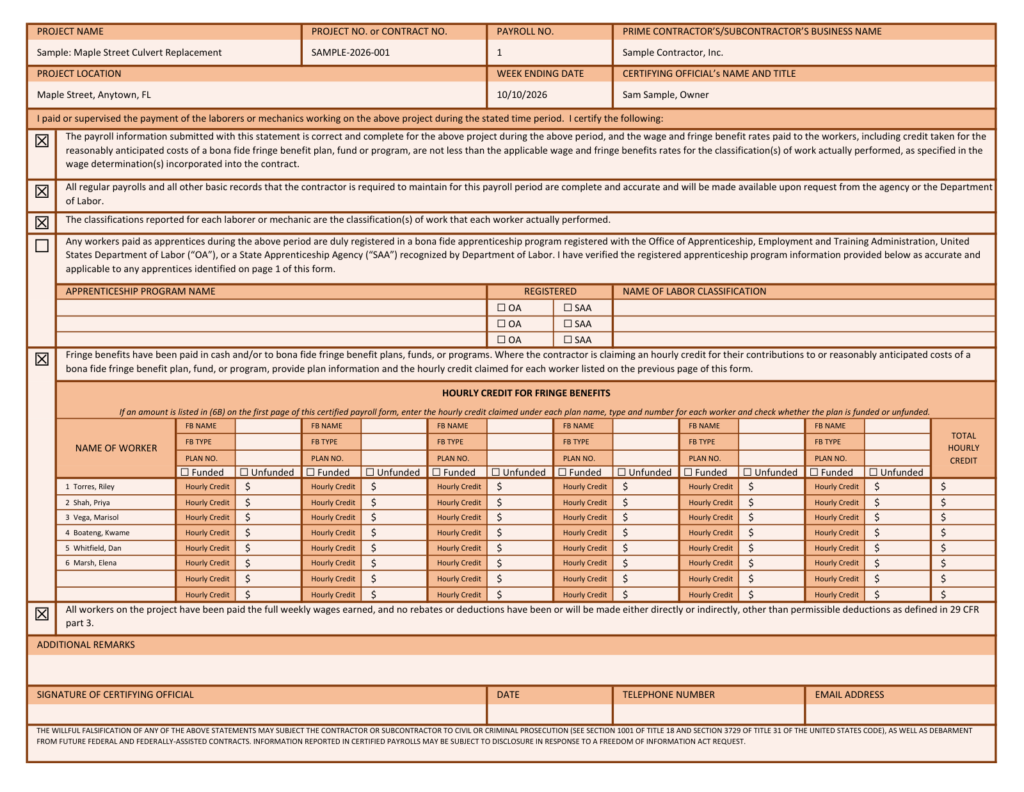
Page 2 as it prints for the sample project: five certifications ticked, the apprentice one left clear because no apprentice is on the payroll, and the fringe one ticked for cash in lieu, so the hourly credit table stays empty. Screen from EG Certified Payroll (WH-347), the Excel workbook that does this.
What the clause requires
29 CFR 5.5(a)(3)(ii) requires each payroll to be accompanied by a Statement of Compliance signed by the contractor or subcontractor, or by the person who supervises the payment of the persons employed under the contract. The regulation lists what the statement must certify, and page 2 of the January 2025 form sets them out as six certifications, each with a box to tick.
The six certifications
The form does not number them. This guide counts from the top, as the DOL’s annotated guide to the form does when it calls the apprentice one box 4.
- The payroll is correct and complete, and the rates are right. That the payroll information submitted is correct and complete for the project and the period, and that the wage and fringe benefit rates paid, including any credit taken for a bona fide fringe benefit plan, fund or program, are not less than the wage determination’s rates for the classifications of work actually performed.
- The basic records. That the regular payrolls and the other basic records the contractor must keep for the period are complete and accurate, and will be made available on request from the agency or the Department of Labor. The records guide lists what they hold.
- The classifications. That the classification reported for each worker is the work that worker actually performed. A worker who did two kinds of work in the week is on two lines, one per classification.
- Apprentices. That any worker paid as an apprentice is registered in a bona fide apprenticeship program registered with the Department of Labor’s Office of Apprenticeship (OA) or a State Apprenticeship Agency (SAA) the Department recognizes, and that the signer has verified the program information in the table under it: the program’s name, OA or SAA, and the labor classification. The apprentice guide covers registration and the ratio.
- Fringe benefits. That fringe benefits have been paid in cash, to bona fide fringe benefit plans, funds or programs, or both, with a table for any plan credit claimed, below.
- Payment in full, and the deductions. That every worker on the project has been paid the full weekly wages earned, and that no rebates or deductions have been or will be made, directly or indirectly, other than the permissible deductions defined in 29 CFR part 3. The deductions guide lists what is permitted.
Then come a space for additional remarks and the signature line, with the date, a telephone number and an email address beside it.
The fringe certification and its table
The January 2025 form has one fringe box, for fringe paid in cash, to plans, or both, and under it a table headed Hourly Credit for Fringe Benefits. The table is filled when column 6B on page 1 has an amount: for each worker, the hourly credit claimed under each plan, with the plan’s name, type and number and whether it is funded or unfunded, and the worker’s total hourly credit. It has room for six plans; the annotated guide asks for an addendum beyond that.
| Page 1 shows | The fringe box | The hourly credit table |
|---|---|---|
| Cash in lieu of fringe in 6C, nothing in 6B | Ticked | Left empty: no plan credit is claimed |
| A plan credit in 6B | Ticked | Each plan, and each worker’s hourly credit under it |
| Both: a plan covers part of the fringe, cash the rest | Ticked | The plan credit only; the cash is in 6C |
A table that is empty while 6B carries a figure, or a credit in the table with nothing in 6B, is a mismatch reviewers notice. Anything more goes in Additional Remarks, under the last certification: the annotated guide names that space for additional information on deductions, the hourly cost of fringe benefits, or explanations.
Who signs
The form asks for the name and title of the signer. It may be the owner or an officer of the contractor, or the employee who actually supervises the payment of wages, such as a payroll manager. The signer is certifying from personal knowledge or from records they supervise, which is why an outside bookkeeper who never sees the timecards is a poor choice.
What a false statement risks
The statement on page 2 says it plainly: the willful falsification of any of the above statements may subject the contractor or subcontractor to civil or criminal prosecution under Title 18 (false statements to a federal agency, 18 U.S.C. 1001) and Title 31 (the False Claims Act) of the United States Code. Beyond that, a payroll that turns out to be wrong exposes the contractor to back wages with interest, and in serious cases to debarment from federal contracting. None of that needs the signer to have intended harm; a carried-over rate that was never checked is the usual road there.
Approval is not certification. Software that lets you approve a payroll is freezing figures so the form reprints the same way later. The certification is the signature on page 2, and the responsibility for what page 1 says stays with the person who signs it.
Common questions
Does the statement have to be on the WH-347 form itself?
No. The regulation requires the certifications; the form is the accepted way to make them. An electronic system that carries the same statements and an electronic signature satisfies the same requirement, if the agency accepts it.
Can I sign for a subcontractor?
No. Each subcontractor signs its own Statement of Compliance for its own workers. The prime collects them and submits them, and is responsible for making sure they arrive.
What if I find a mistake after signing?
Submit a corrected payroll for that week, marked as a correction, with any back wages paid and shown. A corrected payroll is far better than a wrong one found later by a reviewer.
Check it before you sign it
EG Certified Payroll fills page 2 from your company settings and the payroll itself: it ticks the apprentice certification only when a registered apprentice or trainee is on the payroll and the fringe one only when fringe is paid in cash or to a plan, fills the apprenticeship and hourly credit tables, and freezes an approved payroll so the form you signed reprints exactly as it was. The video near the top of this page reads page 2 box by box on the sample project, then checks the week, fixes the two findings and approves it.
See EG Certified Payroll (WH-347)Free trial, the full product; every printed page carries a TRIAL COPY mark until a license is activated. Excel for Windows or Mac.
More in this series: What Form WH-347 Is, Who Files It, and How Often · Deductions on Certified Payroll: What the Copeland Act Allows · All certified payroll guides
★★★★★
“Most likely one of the best freelancers I’ve had the opportunity of working with. I would highly recommend David for any complex VBA coding. We’ll be working with him again in the future.”
VBA Development Client · via Upwork, 2020
5.0★ across 230+ client reviews · 100% Job Success on Upwork · Building Excel tools since 2010 · Read the reviews →