
Labor Burden Calculator: Your Real Cost and Hourly Rate (Free Excel)
Labor burden is what an employee costs you on top of the wage: payroll taxes, workers’ comp, benefits and the paid hours no customer is billed for. A $30-an-hour tech with 120 hours of paid time off, 100 hours of overtime and three-quarters of the hours worked billed to customers costs you about $84,834 a year, or $54.91 for every hour you can bill, once payroll taxes (each stopped at its wage base), workers’ comp and benefits are added. That is what your hourly rate has to cover before overhead and profit. The calculator below works it out for one employee, adds your overhead and the margin you want, and gives the rate; the free Excel workbook does the same for a crew of up to 50. EG Quote & Invoice then keeps that rate, and the cost behind it, in the price list you pick every quote line from.
An estimate, not tax or legal advice. Payroll tax rates for wages paid in 2027, as read on November 16, 2026: Social Security 6.2% of wages up to $192,300 (SSA); Medicare 1.45% of all wages (IRS Topic 751); FUTA 0.6% of the first $7,000 of each employee’s wages, after the 5.4% credit for paying state unemployment tax (IRS Topic 759). Your state unemployment rate and wage base and your workers’ comp rate are yours to type in.
Work out one employee’s cost and rate
Type one employee’s pay, hours and benefits, your state’s unemployment rate, your overhead and the margin you want. The calculator runs in your browser and sends nothing you type.
If the calculator does not show, the free workbook below does the same, for a whole crew.
Markup vs margin converter
Margin is profit as a share of the price; markup is profit as a share of the cost. They are not the same number: adding 30% to a cost gives a 23.1% margin, not 30%.
If the converter does not show, the workbook’s Markup vs margin sheet does the same.
A worked example: the $30 tech
One full-time employee at $30 an hour, paid for 2,080 hours a year (40 a week), with 120 hours of paid time off and 100 hours of overtime, billed to customers for 75% of the hours worked. The state unemployment rate and wage base, 2.7% on $9,000, are example values; use your own state’s.
| Cost a year | Amount |
|---|---|
| Wages: $30 x 2,080 paid hours, plus 100 overtime hours at $45 | $66,900.00 |
| Social Security: 6.2% of $66,900 (under the $192,300 wage base) | $4,147.80 |
| Medicare: 1.45% of $66,900 | $970.05 |
| FUTA: 0.6% of the first $7,000 | $42.00 |
| SUTA: 2.7% of the first $9,000 | $243.00 |
| Workers’ comp: $6.00 per $100 of $65,400, the overtime premium left out | $3,924.00 |
| Health insurance: $500 a month | $6,000.00 |
| Retirement match: 3% of wages | $2,007.00 |
| Other benefits: uniforms, tools, phone | $600.00 |
| Total cost, 26.8% on top of wages | $84,833.85 |
The hours: 2,080 paid, less 120 of paid time off, plus 100 of overtime, is 2,060 hours worked. Three-quarters of them billed is 1,545 billable hours. $84,833.85 / 1,545 = $54.91 for every hour you can bill. If every hour worked were billable the same tech would cost $41.18 an hour; the drive time, shop time and callbacks no customer pays for make up most of the difference.
Now the company. With $60,000 of overhead a year (vehicles, rent, insurance not rated on payroll, office, software, marketing) spread over the crew’s 4,500 billable hours, overhead is $13.33 an hour and break-even is $68.24. At a 20% margin the rate is $68.24 / 0.80 = $85.30, a 25% markup on the full cost. Rounded up to $86, the margin is 20.7% and the markup 26.0%.
Why most free calculators get FUTA and SUTA wrong
Both unemployment taxes are charged only on each employee’s wages up to a wage base, and FUTA comes with a credit. Calculators that apply a flat percentage to all wages miss one or both, and the error lands in your rate. On the $66,900 tech above:
- FUTA at 6.0% of all wages: $4,014. 6.0% is the rate before the credit, and it applies only to the first $7,000. The usual FUTA is $42.
- FUTA at 0.6% of all wages: $401. The right rate on the wrong base.
- FUTA at 6.0% of $7,000: $420. The right base without the credit of up to 5.4%. You get the full credit when you pay your state unemployment tax in full and on time and your state is not a credit reduction state; in one, add that state’s reduction to the 0.6%, as the Department of Labor lists it each year.
- SUTA with no wage base: $1,806. Every state taxes wages only up to its own base. At 2.7% on a $9,000 base it is $243.
- Every paid hour counted as billable. A rate that divides the cost by paid hours, or counts the wage of the billable hours only, leaves out the paid time off, drive time and shop time someone still pays for: the gap between $41.18 and $54.91 above.
This calculator stops Social Security, FUTA and SUTA at their wage bases for each person, and counts the hours you can bill separately from the hours you pay for.
What it leaves out
- Estimating a job: materials, takeoffs and quotes. That is the quote’s work, not the rate’s.
- Prevailing wage and Davis-Bacon fringe rules.
- The employee’s side of payroll: withholding, and the additional 0.9% Medicare tax, which has no employer share.
- State programs beyond the boxes given. A state disability or paid leave program goes in “Other employer payroll taxes”.
- A partial year. The wage bases assume a full year with you, from January.
- Your own taxes as an owner. An Owner gets no payroll taxes here; your self-employment tax is personal, so set your pay high enough to cover it. An owner on payroll, an S corporation owner for example, is an employee.
It is an estimate, not tax or legal advice. Check the rates against your own state notice and insurance policy.
Free Labor Burden and Rate Calculator (Excel)
Your whole crew, up to 50 people, each with their own cost and rate and a rate for the crew; ten lines of overhead; a table of what each billable hour pays for; and a markup and margin sheet with tables. Owners can add themselves without payroll taxes. Formulas only: no macros, no sign-up, and nothing leaves the file.
Download the free workbook (.xlsx)
Version 1.0.1, with the payroll tax rates for wages paid in 2027. It uses only functions Excel 2016 has, and it is tested in Excel for Microsoft 365 on Windows and Excel for Mac (version 16.89); uploaded to Google Sheets, it gives the same results.
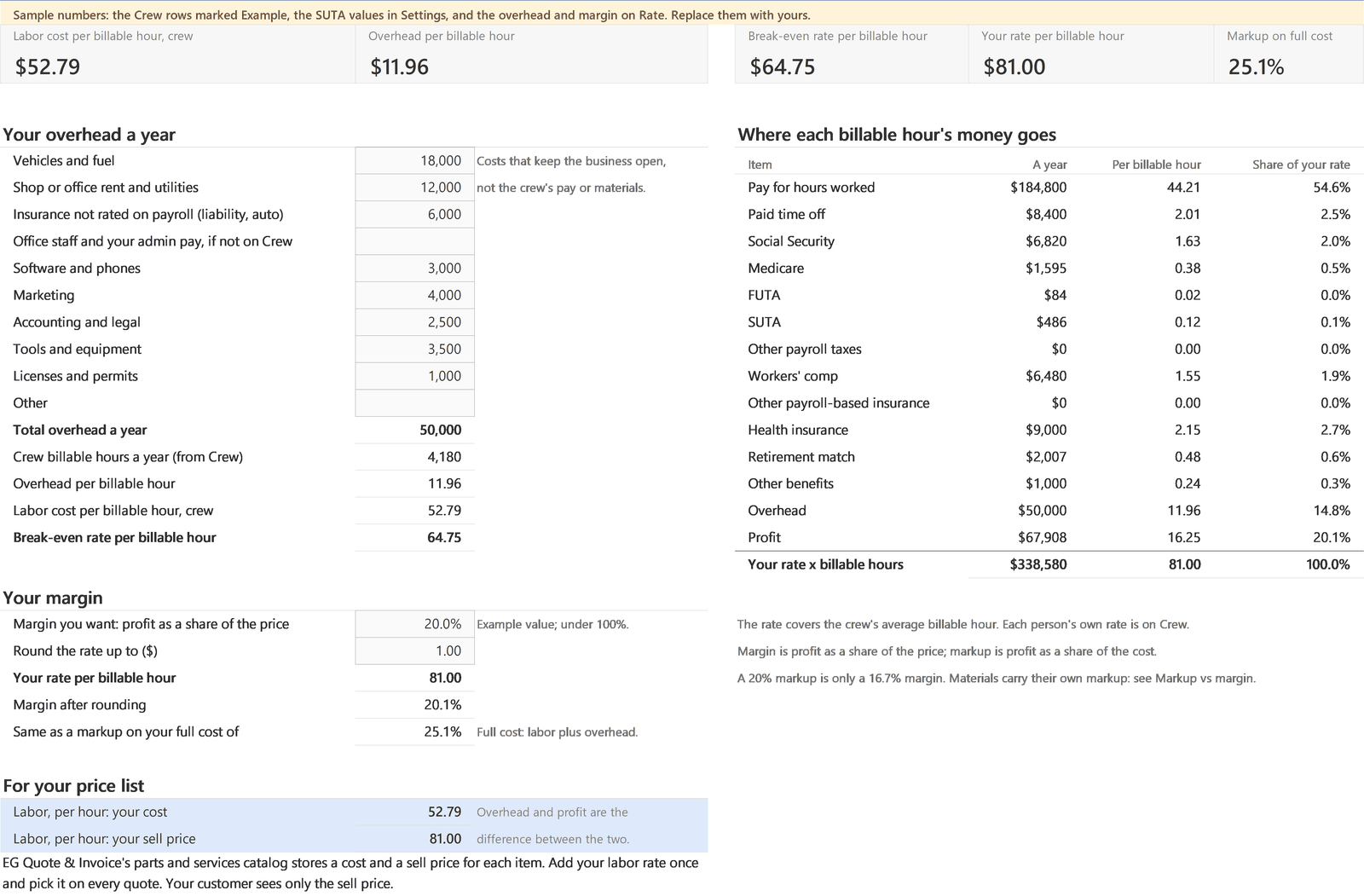
The Rate sheet of the free workbook, with its sample numbers: the crew’s cost, the overhead, the rate at a 20% margin and the pair for your price list.
Common questions
What is a good labor burden percentage?
There is no single right number, because it depends on your state’s unemployment tax, the workers’ comp rate for the work and the benefits you give. In the worked example on this page, a $30-an-hour tech with health insurance and a 3% retirement match carries a 26.8% burden on wages. What matters more for your price is the cost per billable hour, which also counts the hours you pay for but cannot bill: that same tech costs $54.91 for every hour billed.
Is a 30% markup a 30% margin?
No. Markup is profit as a share of the cost; margin is profit as a share of the price. Adding 30% to a $100 cost gives a $130 price and $30 of profit, which is a 23.1% margin. A 30% margin on a $100 cost needs a $142.86 price, a 42.9% markup.
Should paid time off be in my rate?
Yes. Vacation, holidays and sick days are paid but not worked, so no customer is billed for them, and the hours you do bill have to pay for them. The calculator counts paid time off in the wages and leaves it out of the hours worked, which raises the cost of every billable hour. In the worked example, 120 hours of paid time off is $3,600 a year.
Put your rate to work
EG Quote & Invoice is free quoting and invoicing software that runs inside Excel for Windows or Mac. Its parts and services catalog keeps a cost and a sell price for each item, so add your labor rate once, with the cost behind it, and pick it on every quote; your customer sees only the sell price. Each line has its own taxable setting, so parts can be taxed and labor not. The free edition has no document limits and no expiry.
See EG Quote & InvoiceFree edition · Excel for Windows or Mac
Sources
As read on November 16, 2026. The rates change each year; the current ones are the ones that count.
- SSA, Contribution and Benefit Base (www.ssa.gov), $192,300 for 2027, Social Security 6.2% for employers
- IRS Topic no. 751, Social Security and Medicare withholding rates (www.irs.gov), Medicare 1.45% for employers
- IRS Topic no. 759, Form 940, Employer’s Annual Federal Unemployment (FUTA) Tax Return (www.irs.gov), 6.0% on the first $7,000, less a credit of up to 5.4%
- U.S. Department of Labor, FUTA Credit Reductions (oui.doleta.gov), the states whose employers pay more
Pricing a trade? Excel invoice templates by trade
★★★★★
“David was awesome! Very flexible, and responsive. Would definitely work with him again.”
Wholesale price book client · via Upwork, 2020
5.0★ across 230+ client reviews · 100% Job Success on Upwork · Building Excel tools since 2010 · Read the reviews →